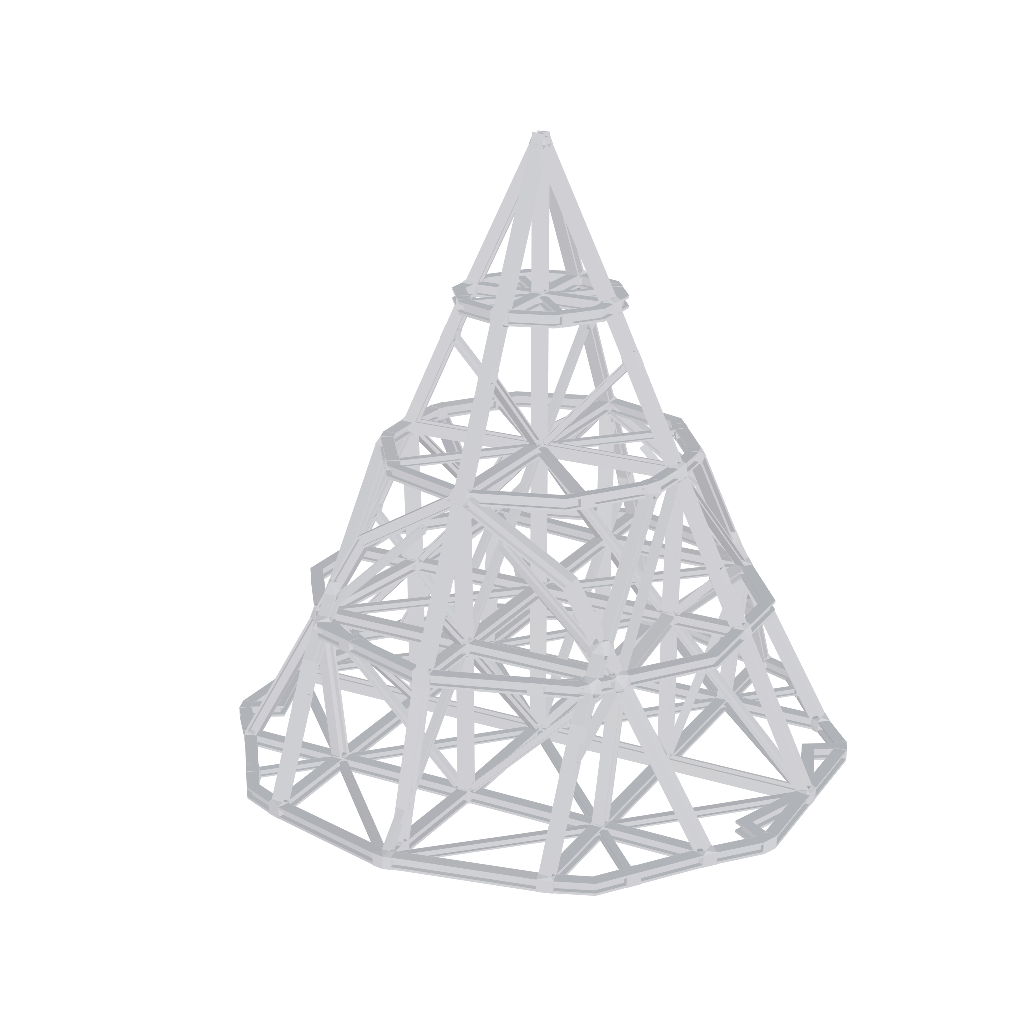
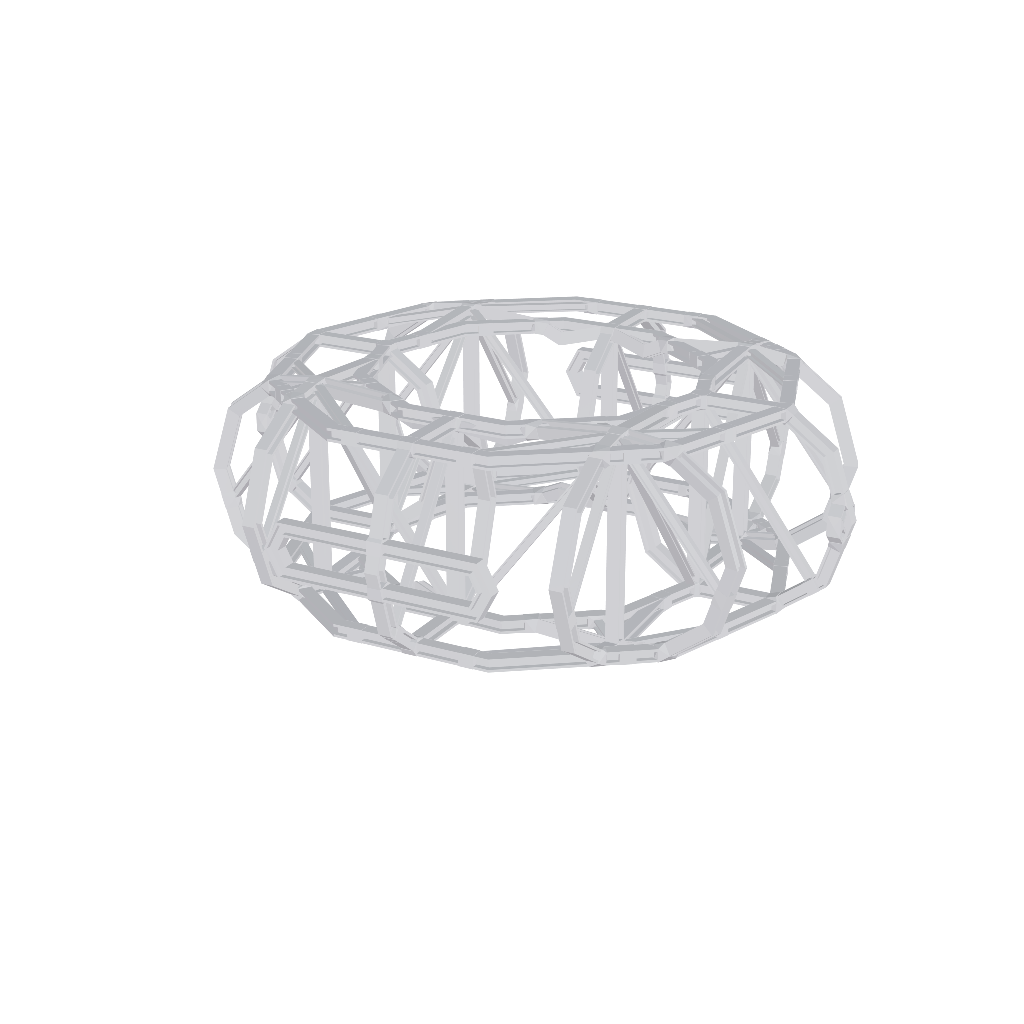
Truss
Replaces a volume with industrial beams and diagonal braces.
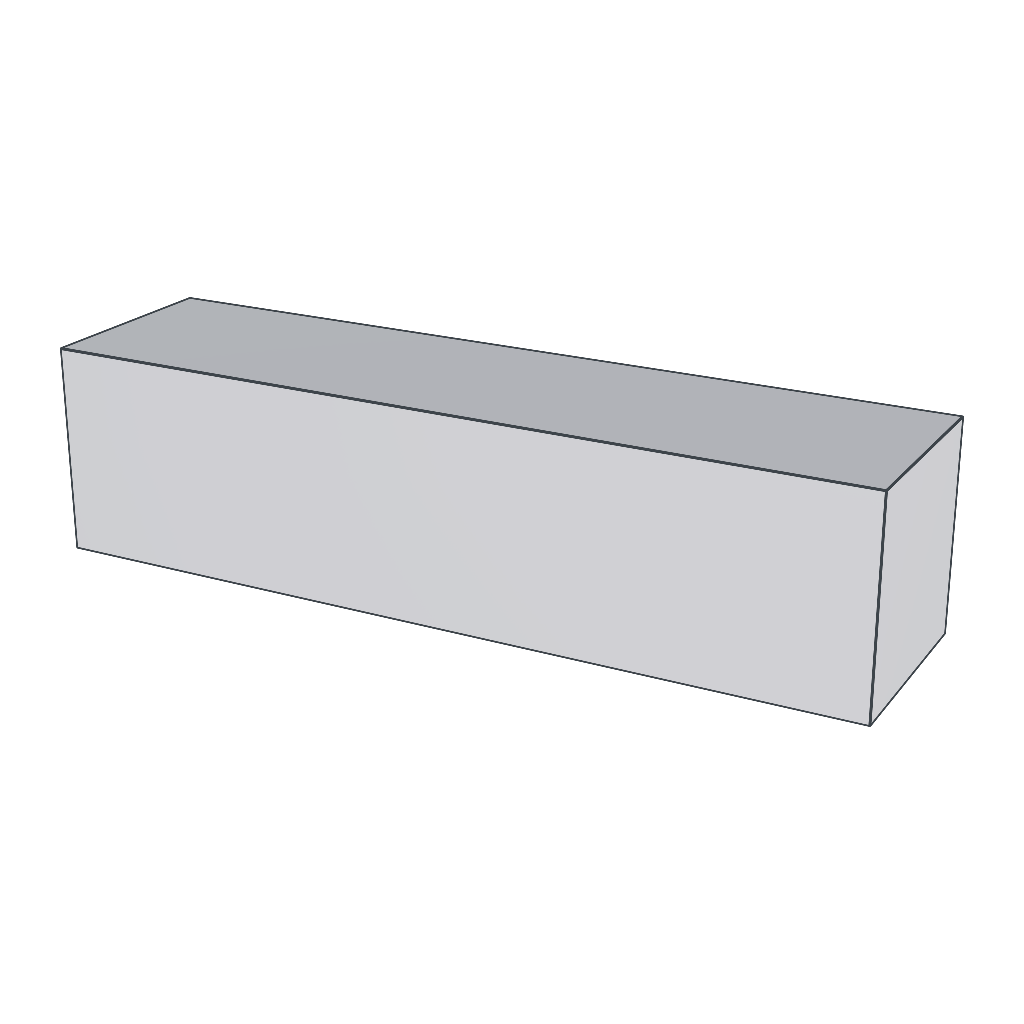
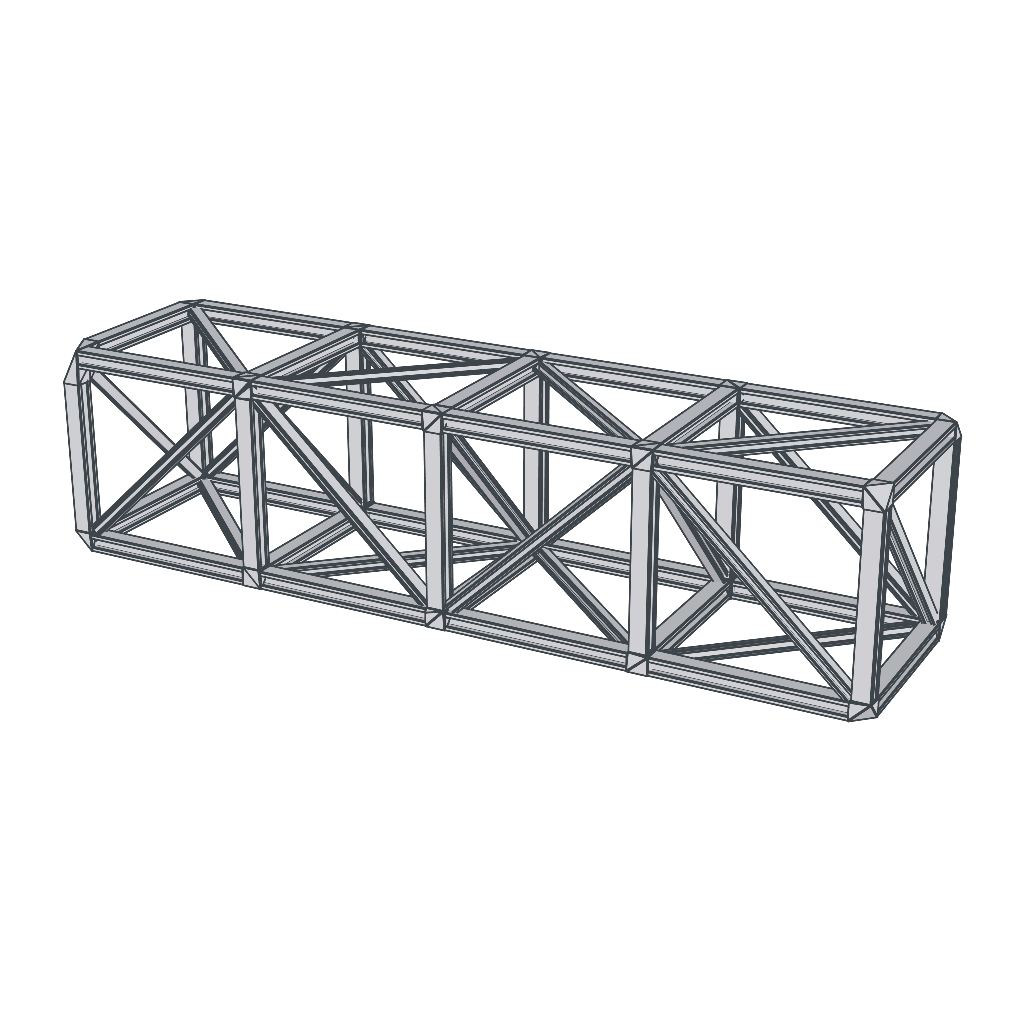
Truss replaces the children's volume with a braced grid, including the model's interior. Add the modifier and drag a mesh into it in the hierarchy. The original stays editable.
Curves, openings and open surfaces
Fit surface is enabled by default. It adds beams along the model's curves and feature edges, connecting the ends of interior members. Spheres retain their rounded outline; gears keep their teeth and center hole even when those details are smaller than a cell.
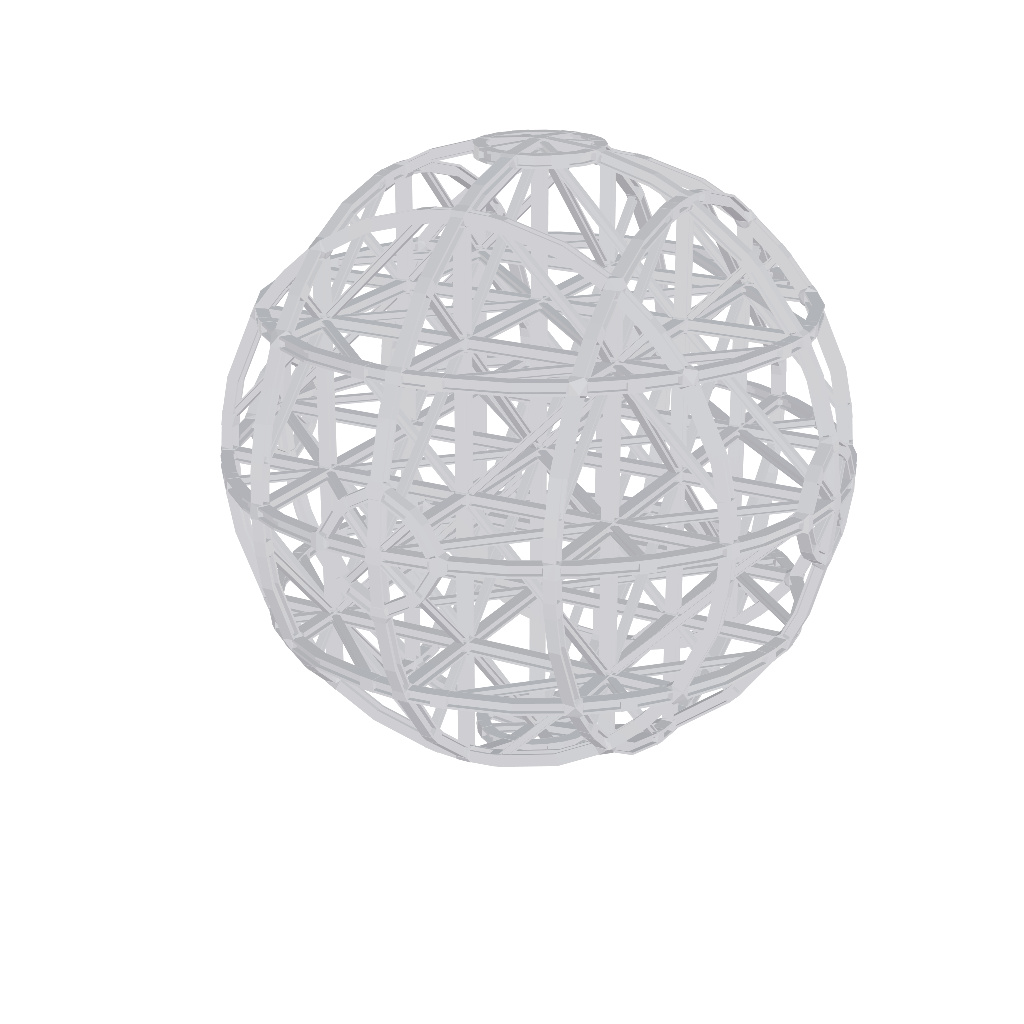
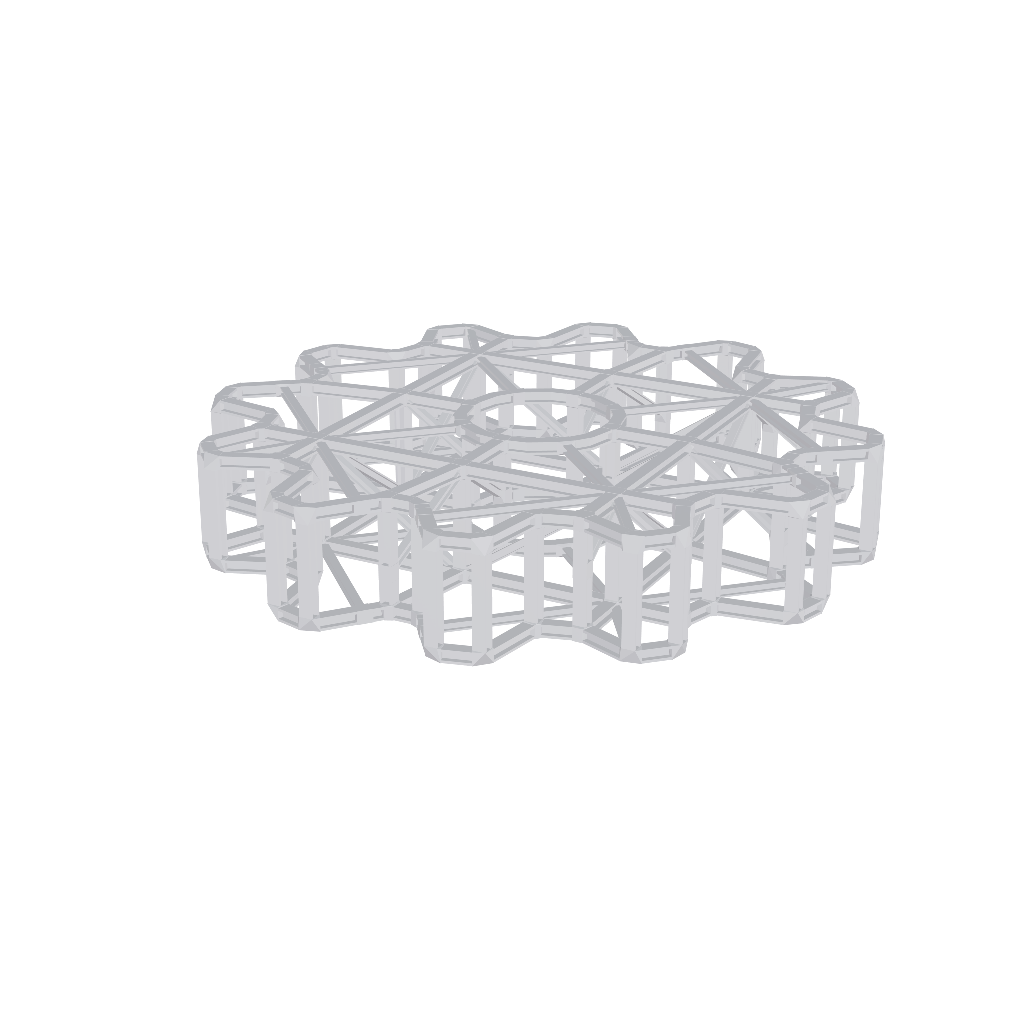
The effect uses mesh geometry rather than primitive types. It also handles disconnected parts and vertex seams. Closed components receive an interior lattice; planes, disks and other open meshes receive surface beams and braces. Turn the option off to use only the interior grid in solids.
Properties
- Fit surface: Fits the frame to curves, openings and mesh boundaries.
- Density: Cell count along the longest axis. Increase it to capture smaller details.
- Detail level: Detail level from 0 to 100 (default 50). Lower values group nearby junctions onto the outermost point of the group and remove internal or duplicate edges; higher values preserve more detail. This does not change the cell count set by Density.
- Beam thickness: Beam width as a fraction of cell size.
- Brace thickness: Brace width relative to the main beams.
- Profile: I-beam, square or round section.
- Bracing: Alternating diagonals, cross bracing or no diagonals.
Beam centerlines are clipped to the mesh, preserving its openings. Cross sections may extend slightly beyond the boundary. Profiles retain their orientation along each beam; compatible bends use shared miter sections. Multiway and acute junctions receive solid connectors enclosing the beam ends. Sub-profile segments are simplified to avoid overlapping pieces. The result is an assembly of solids with internal intersections, without a global Boolean union or rivets.
Straight runs of equal thickness remain continuous, without sampling seams. Regular fittings are sized from the main beam; elongated connectors are limited to converging tips.
Aligned edges with full or partial overlap are consolidated even when their subdivisions differ. Brace attachment points are preserved; parallel beams that would run through each other or leave less than half a width of gap between them are always merged into one; edges farther apart can be grouped according to the detail level. A wall thinner than three beam widths is treated as a shell: both faces fall onto the outer face and the cage becomes a single line, with no interior bars crossing the wall.