Ambient occlusion
Darkens corners and contacts where the ambient light cannot reach.
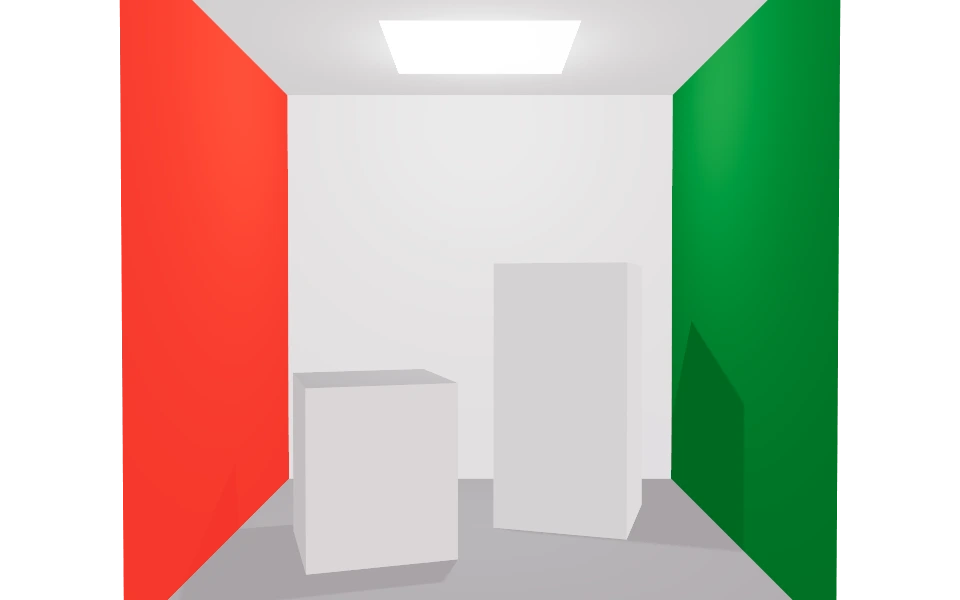
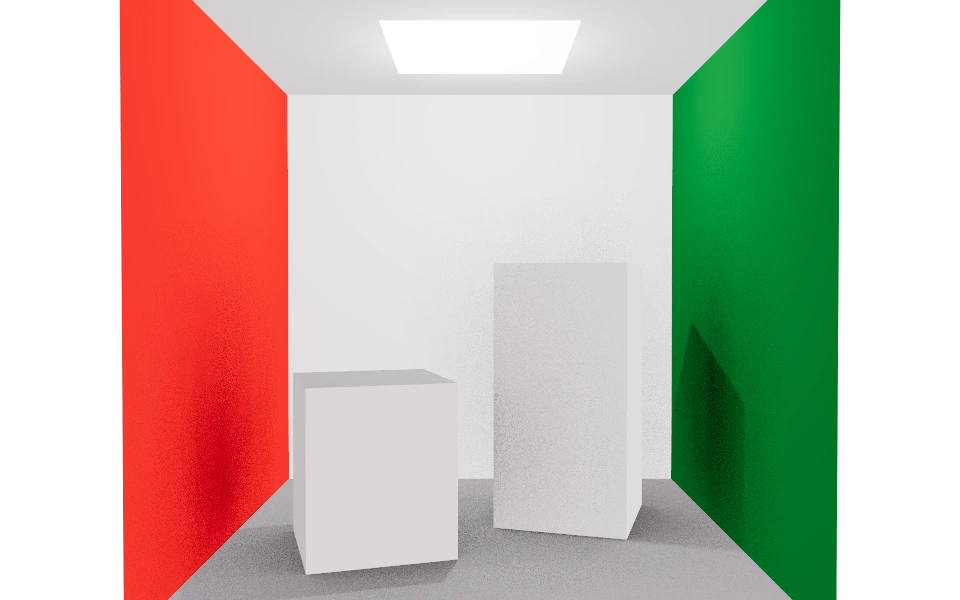
The Ambient occlusion section asks, for every point on a surface, how much of the sky it can see. Where the view is blocked by nearby geometry, less ambient light arrives and the point darkens: corners, edges, gaps and the region where one piece meets another.
This is what gives the model weight. Without it, as in the first image, the boxes look pasted onto a flat drawing; with it, they start to rest on the floor.
Controls
- Enable ambient occlusion: Turns the computation on.
- Distance: How far, in meters, neighboring geometry counts, from 0.1 to 10. A small value marks only the contact; a large one darkens whole rooms.
- Intensity: How much the darkening weighs, from 0 to 2.
How to use it
Set the distance by the scale of what is open: half a meter or so for a tabletop object, several meters for an interior. Intensity above 1 darkens more than physics would, which sometimes helps low poly models with few faces.
Occlusion is traced with a handful of rays per pixel, so it shows some graininess in the darkened areas. Raising the antialiasing samples does not reduce it, because each pixel is shaded only once. When the graininess gets in the way, the answer is global illumination, which replaces the approximation with real visibility and disables this section while it is on.